A far cry from his accountancy training in his home country of Madagascar, Erick Rajaonary became an entrepreneurial industrialist completely by chance. “It all began with a conversation I had with my friends, when we were talking about guano and its potential to make Madagascar a vital part of the fertiliser market,” he explains.
At the time of this conversation, he knew next to nothing about agriculture, and even less about creating fertilizers. However, in the space of 10 years, Rajaonary has become an accepted and recognised industrialist in this sector as the owner of a fertiliser manufacturing company.
What’s more, Rajaonary’s company is unique in its use of guano, or bat droppings, as an organic base for the fertilizer, earning Rajaonary the nickname ‘Batman’ and winning the company the Africa Entrepreneurship Award in 2013. From mid-2015, Rajaonary has equally become the head of one of the most powerful employment organisations in Madagascar, the FIVMPAMA (a collective formed by various Madagascan CEOs).
The key to Rajaonary’s success can surely be attributed to the tiny, vital creature at the heart of this fertiliser company; a creature that is found in abundance throughout Madagascar and yet is rarely loved or appreciated.
“When people think of bats, they normally see them as gross, smelly animals, or as something straight out of a Dracula film,” says Dr Steven Goodman, author of the guidebook The Bats of Madagascar. Beyond these culturally imbued preconceptions, the Madagascan bats – divided into the “ramanavy” insectivore species, and the “fanihy” fruit-eaters – are hunted for their meat to the point of becoming endangered.
“Whatever our perception of these creatures, they constitute an essential part of the overall forest eco-system and the pollination cycle of the baobab,” adds the researcher, referencing the native African fruit-bearing tree.
Above and beyond their ecological role, the 44 bat species found in Madagascar equally provide the raw material used in fertilizer production: the excrement known locally as guano. The droppings mix with the limestone found in the caves where they take refuge, and also combine with the bodies of dead animals to form a rich mixture of huge future potential.
By allowing this substance to mineralise over a period of around 20 to 30 years, it takes on incredible fertilizing properties. This natural mixture becomes rich in minerals, such as nitrogen, phosphorus, calcium and zinc, which are necessary ingredients in the healthy growth and development of plants.
The fertilizing properties of bat guano have been used since the 1920s by the Madagascan riverside villages and on a small local scale. However, it was only in 2006, with the launch of Erick Rajaonary’s company that this source was made accessible on a larger scale. After that initial light-bulb conversation with his friends, he decided to visit some caves in the south of the country, and discovered first-hand the potential lying disused and hidden under the Madagascan earth.
In one cave alone, Rajaonary says that he saw “3000 to 4000 tonnes of guano which no one had ever managed to extract.” His decision was made: he would become the first Madagascan businessman to tap into this raw material and to commercialise it, both on a national and an international level. With his initial 200,000-euro financial injection, drawn from both his savings and through loans from the bank, he launched Guanomad: a manufacturing company able to form organic fertiliser from mineralised bat droppings.
From this point, the business swiftly expanded. Any initial apprehensions passed by and the product made its market breakthrough. In a space of two years, their guano processing plant increased its production to 40 times the original amount.
Thankfully, the Madagascan government’s green revolution programme was also a driving factor, helping Guanomad to turn its 300-tonne production level in 2006 to a whopping 13,000 tonnes in 2008. The product sold itself, in being an organic fertiliser that could also help to protect the quality of the soil whilst proving environmentally friendly.
At their disposal lies a series of 120 caves with a rich reserve of 400,000 tonnes of guano, lying at their feet in their native Madagascar. This country became their primary marketplace, with around 75% of the population living in rural zones and therefore a resulting high dependency on agriculture.
However, success like this is never guaranteed to last forever. The Malagasy political crisis between 2009 and 2013 had its effects on the market, putting a metaphorical spanner in the Guanomad works. To try to keep their place in the market, they decided to give the suffering farmers a hand by granting loans, which then facilitated a continuing use of their products.
With the cooperation of a couple of farming associations and NGOs, they decided to launch projects for the farmers, requiring the distribution of seeds and farming materials. Through this process, the Batman still managed to promote his products whilst also providing support for the farming community. Simultaneously, the company managed to launch its product on the international market, where it now sells around 50% of its material across Europe, Canada, U.S.A. and throughout Africa.
In 2010, Guanomad obtained Ecocert certification, which confirms the “organic” nature of their products, and therefore allows the company to access a demanding market which has so far been dominated by South American guano. “Our products do not contain any additional chemicals,” affirms Narinda Raharijaona, director of Guanomad’s communications and marketing.
Guanomad equally manages to turn any potential environmental or socio-cultural constraints to its own advantage. “Before extracting any guano from a cave which is listed as a sacred place for the riverside communities, we make sure we ask the villagers for permission,” explains Erick Rajaonary.
Where the environment is concerned, the company takes all of the necessary steps to limit any damage caused to the bats’ natural habitats by its mining operations. On an economic front, the company is able to provide rebates to the various communities situated close to where they extract the material, whilst also providing employment to village members living in these localities.
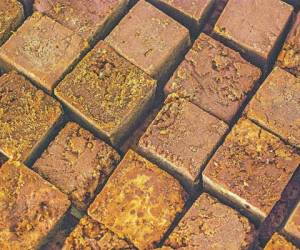
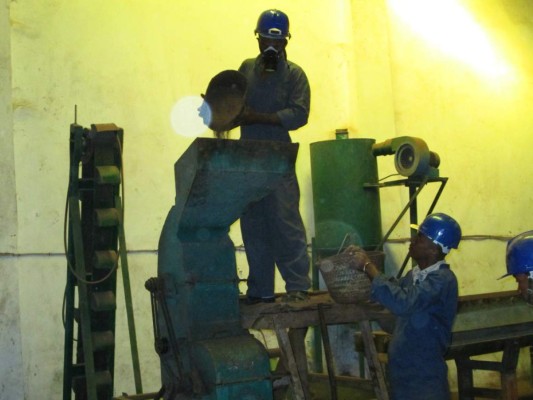
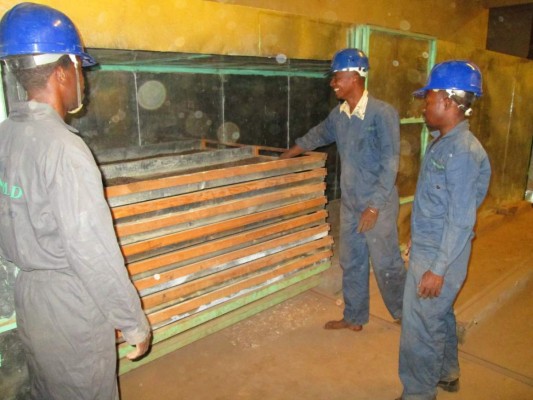
Once it has been extracted from the caves, the guano is taken to the production plant, where it is then dried, mixed, crushed and formed into pellets. If they are going to be sold in stick-form, they are then dried again. If they will instead be sold in powder or pellet form, the material undergoes a thermal treatment, which is then re-cooled prior to being packaged and distributed.
The guano is sold through one of the 250 points of sale they have available across Madagascar, or on the international market. Today, Guanomad is the provider of 7 different types of guano-based products, adapted to various types of agricultural needs, from material for organic farms, to gardens, and even to fruit tree plantations.